
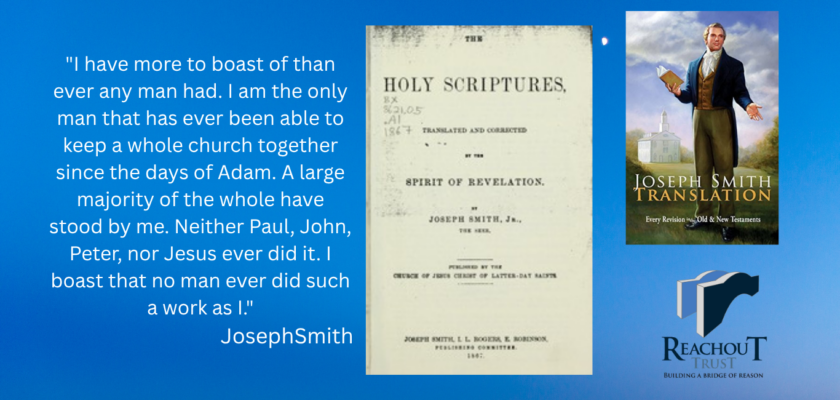
We have looked at the Mormon Church’s cautious introduction of modern Bible translations in the Spring 2026 Newsletter. The question left unaddressed is that of the Joseph Smith Translation (JST), known as the ‘Inspired Version’ in the Reorganised Church. Why is Joseph Smith’s own ‘inspired’ work not on the list?
There are a range of reasons why the Salt Lake Church doesn’t use the JST. The one you will hear most is, ‘it was not fully completed, published, or finalised by Joseph Smith before his death.’ It’s not really an explanation, and like most Mormon claims you are meant simply to accept it. The truth is, Smith considered his work finished by July 1833, although he continued to refine it.
‘On July 2, 1833, a letter from the First Presidency, including Joseph Smith, Sidney Rigdon, and Frederick G. Williams, in Kirtland to the Saints in Zion recorded that they “this day finished the translating of the Scriptures, for which we returned gratitude to our heavenly father.”
It isn’t a translation, the Salt Lake Church now acknowledges, since Smith knew no ancient languages, had no access to ancient documents, therefore there is no scholarship involved. It was a revision of the King James Bible, including ‘clarifications, corrections, and new revelations.’
Today’s Mormon Church considers the JST as ‘inspired commentary.’ Smith saw himself continuing to fulfil his role as prophet, producing ever greater clarity to the Bible according to divine command. Those that came after him increasingly saw issues with the text and gave it a status not much greater than the once-inspired Journal of Discourses.
What he did was take a contemporary commentary, Adam Clarke’s Commentary, and dig out of it the ideas that best suited his thinking. A close friend of John Wesley, Adam Clarke (c. 1760/1762–1832) was an influential Irish-born British Methodist theologian, preacher, and biblical scholar best known for his comprehensive 40-year project, the Commentary on the Holy Bible. If Smith had but stuck to that he might not have gone so far astray, but power tends to corrupt, and absolute power corrupts absolutely, so it is said, and so ’it came to pass.’
The Joseph Smith Translation (JST) original manuscript was held by his wife Emma after his death and became the property of the Reorganised Church, known today as the ‘Community of Christ.’ That original manuscript was transferred to the Salt Lake City Church in 2024. Selling off its heritage a piece at a time seems the way the Reorganised Church continues to survive. Before this sale, they sold the Kirtland temple to the Salt Lake City church in 2023. Being a product of the 19th century, the JST is now in the public domain, although specific editions may have copyright restrictions.
The JST was intended to restore what Smith described as “many important points touching the salvation of men, [that] had been taken from the Bible, or lost before it was compiled” (Teachings of the Prophet Joseph Smith, 16 February 1832, pp. 10–11) hence ‘inspired.’ After all, Mormonism is a restorationist movement and such movements always seem to find things to restore that no one has come across until now, otherwise they are pretty redundant.
The work contains over 3,000 changed verses, including significant additions. While the Salt Lake Mormon Church doesn’t use it, sections are included in the footnotes and endnotes of their annotated ’preferred edition,’ the KJV.
Joseph Smith in Genesis
Perhaps the most audacious addition is found in Genesis 50:
‘And that seer will I bless, and they that seek to destroy him shall be confounded; for this promise I give unto you; for I will remember you from generation to generation; and his name shall be called Joseph, and it shall be after the name of his father; and he shall be like unto you; for the thing which the Lord shall bring forth by his hand shall bring my people unto salvation.’
This is at the end of a much longer peroration from Joseph of Egypt to his brothers in the JST. In our Bibles Genesis ends at verse 26, but in Joseph Smith’s Bible it ends at verse 38, with the death of Jacob’s favourite son. Those twelve extra verses contain prophecies of:
- Moses and the establishment of Israel (v.24)
- The migration to America that begins the Book of Mormon (v. 25)
- The appearance of Christ in the Americas (v. 25)
- The coming of Joseph Smith (v.26)
- The mission to the Lamanites (vv.27/28)
- A favourable comparison between Joseph Smith and Moses (v:29)
- The coming forth of the Book of Mormon (v. 30)
- The bringing together of the Bible and the Book of Mormon (v. 31)
- The naming of Joseph [Smith] and favourable comparisons with Joseph of Egypt (v. 33)
- The wanderings of Israel in the desert (v. 34)
- The giving of the Ten Commandments and the naming of Aaron (v. 35)
The last three verses (36-38) parallel verses 24-26 in our Bibles, with some flourishes.
There is an insight here into the workings of his mind. A man with a good mind and a decent education, an appetite for adventure, and a romantic turn of mind, a fantasist who would deny himself nothing, he would have found the stories in Genesis thrilling. It isn’t difficult to imagine his reading the exciting story of Joseph in Egypt, romantically identifying with him as boy/saviour, and having the same name, seeing opportunity.
It wouldn’t take a genius to write his strange Mormon narrative, and himself, into a part of the Bible that lends itself to prophecy. I would suggest that most of his revelations are as freewheeling and opportunistic. In these twelve verses you have a rough synopsis of the message of Mormonism.
This significant addition is entered into the endnotes of the official King James Bible of the church, along with several pages of additions too long to include in footnotes.
Joseph Smith Translation and Jesus’ Childhood
Joseph Smith couldn’t resist the temptation to satisfy peoples’ curiosity about the ‘missing years’ in Jesus’ life, and so he added to Matthew’s gospel:
‘And it came to pass that Jesus grew up with his brethren, and waxed strong, and waited upon the Lord for the time of his ministry to come.
‘And he served under his father, and he spake not as other men, neither could he be taught; for he needed not that any man should teach him.
‘And after many years, the hour of his ministry drew nigh.’ Mt.3:24-26
He is saying little more than others had said before him. He simply wanted to claim this ‘insight’ as his own, to demonstrate his prophetic calling. He knew his Bible well enough for this task. The phrase, ‘he needed not that any man should teach him,’ is adapted from 1 John:
‘As for you, the anointing you received from him remains in you, and you do not need anyone to teach you. But as his anointing teaches you about all things and as that anointing is real, not counterfeit—just as it has taught you, remain in him.’ 1 John 2:27
This is a quite primitive but impressive inventiveness on Smith’s part, who compares himself favourably with Jesus. All he needed was a willing audience that didn’t know the Bible as well as he did, that didn’t ask too many questions, and that simply wanted there to be an American prophet.
Then there is this curious entry in Luke’s gospel where he invents an urgent discussion among the disciples, much as is found in Mark 8:16,17; 9:33,34:
‘But he who denieth me before men, shall be denied before the angels of God.
‘Now his disciples knew that he said this, because they had spoken evil against him before the people; for they were afraid to confess him before men.
‘And they reasoned among themselves, saying, He knoweth our hearts, and he speaketh to our condemnation, and we shall not be forgiven. But he answered them, and said unto them,
‘Whosoever shall speak a word against the Son of Man, and repenteth, it shall be forgiven him; but unto him who blasphemeth against the Holy Ghost, it shall not be forgiven him.’ Luke 12:9-12
In verse twelve Smith seems to be trying to understand men being forgiven for blaspheming against the Son. He adds ‘and repenteth’ so it makes sense to him. This is what he seems to be doing with the prologue in John’s gospel. Smith is not a Trinitarian, John clearly is.
Joseph Smith Translation and John’s Prologue
‘In the beginning was the Word, and the Word was with God, and the Word was God. He was in the beginning with God. All things were made through him, and without him was not anything made that was made. In him was life, and the life was the light of men.’ John 1:1-4
This is what Adam Clarke had to say about John’s opening verses:
‘In the beginning – That is, before any thing was formed – ere God began the great work of creation. This is the meaning of the word in Gen 1:1, to which the evangelist evidently alludes. This phrase fully proves, in the mouth of an inspired writer, that Jesus Christ was no part of the creation, as he existed when no part of that existed; and that consequently he is no creature, as all created nature was formed by him: for without him was nothing made that is made, Joh 1:3. Now, as what was before creation must be eternal, and as what gave being to all things, could not have borrowed or derived its being from any thing, therefore Jesus, who was before all things and who made all things, must necessarily be the Eternal God. Was the Word – Or, existed the Logos. This term should be left untranslated, for the very same reason why the names Jesus and Christ are left untranslated. The first I consider as proper an apellative of the Savior of the world as I do either of the two last. And as it would be highly improper to say, the Deliverer, the Anointed, instead of Jesus Christ, so I deem it improper to say, the Word, instead of the Logos. But as every appellative of the Savior of the world was descriptive of some excellence in his person, nature, or work, so the epithet Λογος, Logos, which signifies a word spoken, speech, eloquence, doctrine, reason, or the faculty of reasoning, is very properly applied to him, who is the true light which lighteth every man who cometh into the world, Joh 1:9; who is the fountain of all wisdom; who giveth being, life, light, knowledge, and reason, to all men; who is the grand Source of revelation, who has declared God unto mankind; who spake by the prophets, for the testimony of Jesus is the spirit of prophecy, Rev 19:10; who has illustrated life and immortality by his Gospel, 2Tim 1:10; and who has fully made manifest the deep mysteries which lay hidden in the bosom of the invisible God from all eternity, Joh 1:18.’ Emphasis added
Standard fare, I think you will agree. This is how John is understood here, how he has been understood since the beginning. Jesus is the eternal Logos, the Word, the clearest and final revelation of God (Heb.1:1-3) If you want to know what God is like, look at Jesus. Now see what Joseph Smith did when he translated the opening verses of John’s gospel:
‘In the beginning was the gospel preached through the Son. And the gospel was the word, and the word was with the Son, and the Son was with God, and the Son was of God…In him was the gospel, and the gospel was the life, and the life was the light of men.’ John 1:1,4 JST
For Mormons, these changes clear up at a stroke the puzzle of the Trinity. Mormonism is henotheistic and teaches a godhead of three gods that stand at the head of a pantheon of gods.
‘The word’ here is no longer the Son (the gospel was the word) it is the message preached through the Son. The Son is no longer the word but the messenger who brings the word. This opens the way for restorationist Mormonism to insist the word, the message, has since become corrupted. I mean, just look at how much this needed ‘correcting.’
Later in the same prologue we read:
‘For in the beginning was the Word, even the Son, who is made flesh, and sent unto us by the will of the Father. And as many as believe on his name shall receive of his fulness. And of his fulness have all we received, even immortality and eternal life, through his grace.’ v.16, JST
This time ‘Word’ is capitalised. He couldn’t abandon altogether what John wrote since the Word clearly became flesh in v.14 of our Bibles. So he effectively gave ‘word’ two different meanings – the gospel word, and the Son Word. The problem is that in John’s prologue ‘Word’ translates the Greek Logos – which literally means ‘Word.’
‘In the beginning was the Logos, and the Logos was with God, and the Logos was God. He was in the beginning with God. All things were made through him, and without him was not anything made that was made. In him was life, and the life was the light of men…And the Logos became flesh and dwelt among us, and we have seen his glory, glory as of the only Son from the Father, full of grace and truth’ John 1:1-4;14
Word cannot mean gospel, which translates the Greek euangélion. However, Smith needs to make John 1 mean something else, something that allows him to change the Trinity doctrine, and to paint a picture of people who reject the message and not the Saviour so that his apostasy narrative can step in and justify his restorationist message with him in the central role.
Joseph Smith Boy/Saviour
It has always been believed among Mormons that Joseph Smith’s coming was anticipated from eternities past:
“Joseph Smith, the Prophet and Seer of the Lord, has done more, save Jesus only, for the salvation of men in this world, than any other man that ever lived in it” (D&C 135:3). What a statement! Though stunning to some, and even shocking to others, it is not exaggeration. The Prophet Joseph Smith single-handedly changed the theological landscape of the world. It was he who, after a long period of apostasy, reintroduced the world to a true knowledge of God the Father. It was he who made known to the world the full and far-reaching saving potential of Christ’s atoning power. It was he who taught the doctrine and put back into operation the powers that enable all who so desire to re-enter the Father’s presence.
‘Latter-day Saints are not the first group of people to comprehend the greatness of Joseph Smith. From the beginning of time, God and His many prophets have known of and declared the coming of Joseph Smith to inaugurate and establish this, the dispensation of the fulness of times. President Brigham Young’s well-known statement on this topic has become a classic but is well worth repeating because it is so mind-expanding! He said:
‘It was decreed in the counsels of eternity, long before the foundations of the earth were laid, that he, Joseph Smith, should be the man, in the dispensation of this world, to bring forth the word of God to the people, and receive the fulness of the keys and power of the Priesthood of the Son of God. The Lord had his eyes upon Joseph, and upon his father, and upon his father’s father, and upon their progenitors clear back to Abraham, and from Abraham to the flood, and from the flood to Enoch, and from Enoch to Adam. He had watched that family and that blood as it has circulated from its fountain to the birth of that man. He was foreordained in eternity to preside over this last dispensation.’ Brigham Young, Discourses of Brigham Young , comp. John A. Widtsoe (Salt Lake City: Deseret Book, 1971), 108.
Joseph Smith created a complete ‘Christian’ counter-culture, with its own historical context, mythology, theology, and culture; almost the perfect cult. It has proved so successful that I often get asked, ‘Mormons are Christian though, aren’t they?’ While the faith of Jehovah’s Witnesses begins with an idea, Adventism, for Mormons their faith begins with a man, Joseph Smith, and Smith made sure they would never forget it. You can read what Mormonism teaches about its founder in this astonishing document. The Impact of the Doctrinal Restoration: How the World Was Different after Joseph Smith

