
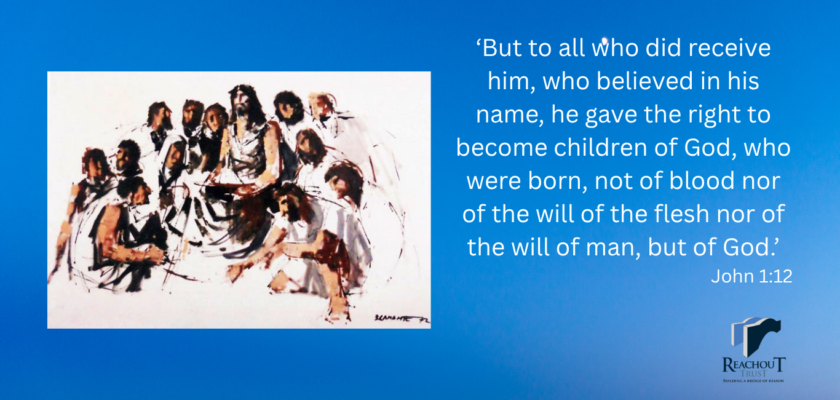
Becoming a Christian is the most radical thing anybody can do.
In the normal way of things, when we are born into this world we are born into a family, within a community, which is part of a wider society, with an established culture that is familiar, confident, and ready to receive us, set up to educate us in its ways by precept but mostly by example. It carries on largely unquestioned, unquestioning, reproducing itself with each successive generation.
It isn’t quite true that no one asks questions of it but most don’t, at least not seriously. It would be wrong to say alternatives to the established order don’t exist, at least in some people’s minds. Just look at the worlds of politics, religion, and cults with their plethora of eutopian dreams. However, while some experiment with these, most cling to the security of the comfortingly familiar customs, tropes, and traditions of their community.
One of the great attractions of cults is their familiar ideas and solutions. If we could just get organised, if we could simply find the right plan, discover the right formula, if we would just learn to do as we’re told by the right leaders.
When people do question, their questions typically revolve around the intractable challenges of life, usually starting with ‘why?’ The apostle Paul describes the struggle in chapter seven of his letter to the churches in Rome. I want to do the right thing, but so often something inside me drives me to do the wrong.
We all know right from wrong, but we are compromised by something in our very nature that draws us to the wrong. We see it readily enough in others, we know that we too often judge others more harshly than we judge ourselves. Others have excuses, apparently, we have ‘reasons.’ G K Chesterton, in answer to the question, ‘What’s wrong with the world?’ said, ‘I am.’
The Word Became Flesh
Into this world comes a man so out of step with the established order that he draws to himself people who had previously simply settled; there are a lot of settlers in the world. What draws them? That is a good question. It begins our insight into how very radical it is, becoming a Christian. People, naturally, have mixed motives, and we soon see this as the story unfolds.
In John’s gospel we read how Jesus gives a sign of his identity and purpose in the feeding of the 5,000. Later, he berates those who seek him out. He says, ‘You are seeking me, not because you saw signs, but because you ate your fill of the loaves. Do not labour for the food that perishes, but for the food that endures to eternal life, which the Son of Man will give you.’ John 6:26,27
Here is the difference between hospitality and holiness. It is possible to see the signs and miss what they signify, with the result that you eat your fill yet remain empty and hungry. You can spend a lifetime in church only to find the habit of custom or the excitement of novelty has robbed you of the radical ‘food that endures to eternal life.’
Others, of course, considered Jesus too dangerous to be allowed to go on living. These are the ones thought of as being in authority over the status quo with which so many seem comfortable. Power, and the possible loss of it preoccupies these people. You see this in the account of his triumphal entry. While crowds greeted him, ‘the chief priests and the scribes and the principal men of the people were seeking to destroy him…’ Luke 20:47
I have wondered how many of those in the first crowd, eating the multiplied bread, shoe-horning Jesus into their idea of what Messiah should be, celebrating his arrival in Jerusalem, were in the second crowd crying, ‘Crucify!’ Perhaps disappointment over the continuing presence of Romans and the curious absence of more sandwiches drove them back to what they knew, and they settled into that familiar routine. The settlers are the enablers of the murderers.
If you’re a settler you will miss the signs of who Jesus is, why he came and what he achieved.
The Second Adam
Jesus is described in the Bible as the second Adam, ’The first man Adam became a living being; the last Adam became a life-giving spirit.’ 1 Corinthians 15:46 Here is the key to radical Christianity. The second Adam didn’t come to establish a new organisation. He didn’t come to show us a better way to continue as we are, to give us our best life now. He came to found a new family, a new community, a new society, in what will eventually be a new world; God’s family in the world as God always intended.
When Jesus stood before Pontius Pilate he was asked, ‘Are you the king of the Jews?’ Jesus answered, ‘My kingdom is not of this world. If my kingdom were of this world, my servants would have been fighting, that I might not be delivered over to the Jews. But my kingdom is not from the world.’’ John18:36
Just as the first Adam is the progenitor of the fallen, broken human race, so the second Adam is the progenitor of the new humanity, a humanity that is not of this world, neither shaped nor defined by it.
The Bible describes us as being ‘in Adam,’ or ‘in Christ,’ who is the second Adam. To be in Christ is to be of that other world, a world of which those of this world, those in the first Adam, know nothing. To be in the first Adam is to share in his fallen nature, his sin, and spiritual death. To be in the second Adam is to be partakers of his righteousness, of eternal life, fitted for that kingdom which is not from this world.
The Second Birth
Entry into the kingdom of Christ, the kingdom that is not from this world, involves much more than simply going to a different country, attending a different church, or keeping company with a better set of people. The change involved in coming to be ‘in Christ’ is so radical the Bible refers to it as a second birth.
In conversation with a first century religious leader named Nicodemus Jesus declared, ‘Truly, truly, I say to you, unless one is born again he cannot see the kingdom of God.’ John 3:3 The gospel writer has already referred to those who are counted ‘children of God.’ In his prologue he writes:
The true light, which enlightens everyone, was coming into the world. He was in the world, and the world was made through him, yet the world did not know him. He came to his own, and his own people did not receive him. But to all who did receive him, who believed in his name, he gave the right to become children of God, who were born, not of blood nor of the will of the flesh nor of the will of man, but of God.’ John 1:9-13
Three groups are in mind here:
The first is the world of which he is Creator, a world that failed to know him. ‘He was in the world, and the world was made through him, yet the world did not know him.’
The second is the Old Testament people of God, Israel, ‘He came to his own, and his own people did not receive him.’
The third are a people who receive him, believe in his name, and to whom membership in God’s family, citizenship in God’s kingdom, is gifted as a right. ‘But to all who did receive him, who believed in his name, he gave the right to become children of God, who were born, not of blood nor of the will of the flesh nor of the will of man, but of God.’
Paul, in describing these people, writes, ‘There is neither Jew nor Greek, there is neither slave nor free, there is no male and female, for you are all one in Christ Jesus.’ Galatians 3:28
John, in the book of Revelation describes those finally around the throne of God as, ‘…a great multitude that no one could number, from every nation, from all tribes and peoples and languages, standing before the throne and before the Lamb, clothed in white robes, with palm branches in their hands…’Revelation 7:9
The Qualification
Did you catch the qualification for membership in this new humanity?
‘…to all who did receive him, who believed in his name, he gave the right to become children of God.’ To all who receive, to all who believe. The ones in the third group may come from either or both of the other two groups. It is into this third group that we are born-again, or ‘born from above.’ John 3:3
This is the new birth, ‘…born not of blood nor of the will of the flesh nor of the will of man, but of God.’ Because, of course, Christ’s kingdom is not from this world, and nothing that is of this world influences what happens in that world. This is a work of God.
John writes, ‘[this] world is passing away along with its desires, but whoever does the will of God abides forever.’ 1 John 5:7 Doing the will of God is not what qualifies us to abide forever, it is the outworking of the gift of new life God has given those who receive and believe. Philip.2:12,13
Just as with our birth into this world, in God’s new world we are born into a family, within a community, which is part of a wider society, with an established culture that is confident, ready to receive us, set up to educate us in its ways by precept and example. However, two things are different.
While we are born-again into God’s kingdom and family, we remain physically in this world.
While we are born-again, we are born again already all too familiar with this world, which uses that familiarity to tempt us back to our old life. On the other hand, our new identity in the second Adam, ‘in Christ,’ is quite unfamiliar. That is why discipleship is so very important.
This new, ‘household of God[is] built on the foundation of the apostles and prophets, Christ Jesus himself being the cornerstone, in whom the whole structure, being joined together, grows into a holy temple in the Lord. In him you also are being built together into a dwelling place for God by the Spirit.’ Ephesians 2:20
To achieve this, Christ gave us his Spirit, each other, a foundation of apostles and prophets, a cornerstone (Christ himself), evangelists, shepherds, and teachers, ‘to equip the saints [believers] for the work of ministry, for building up the body of Christ, until we all attain to the unity of the faith and of the knowledge of the son of God, to mature manhood to the measure of the stature of the fulness of Christ, so that we may no longer be children, tossed to and fro by the waves and carried about by every wind of doctrine.’ Eph.4:11-14
Radical Christianity begins internally and over time works itself out externally in the radical new community of the church.
What’s wrong with the world? I am, you are. But we have the answer:
‘Christ in you the hope of glory. Him we proclaim, warning everyone and teaching everyone in all wisdom, that we may present everyone mature in Christ.’ Col.127,28

