
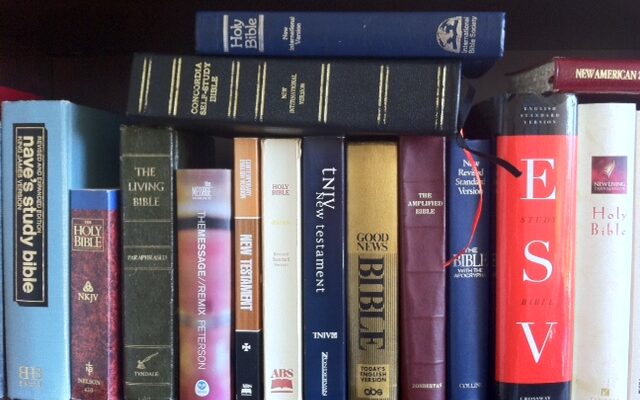
A December 2025 newsroom article reports on a specific change in the latest General Handbook regarding Bible translations Mormons are encouraged to use.
The handbook notes that ‘generally, members should use a preferred or Church-published edition of the Bible in Church classes and meetings.’ In English that is the King James Version.
‘The adjusted handbook section also points to examples of English Bible translations that members can consider as they seek to better understand the teachings of the Hebrew Bible and the New Testament.’
The organisation has always favoured the King James Bible and emphasises, ‘Church-published editions of the Bible include footnotes, subject indexes, and other study aids.’ It has, indeed, spent a lot of time, energy and money combining the KJV it with Mormonism’s other holy books; the Book of Mormon, Doctrine and Covenants, and the Pearl of Great Price, and other teaching materials.
A cynic might observe that the King James Bible lends a certain legitimacy to the others because all are written in King James English.
Elder Dale G. Renlund of the Quorum of the Twelve Apostles, the article tells us, says the KJV is “beautiful and powerful,” but for some it can be difficult to understand. He is quoted as saying:
“We can confidently gain insights from multiple translations [of the Bible], in part because ‘we also believe the Book of Mormon to be the word of God.’ Latter-day scripture, including the teachings of living prophets, is a good standard for evaluating any doctrinal discrepancies that might come up in different Bible translations.”
For those worried about using a new Bible translation, Elder Renlund says to rely on the robust resource that is modern revelation.
The handbook explains that the Church “identifies editions of the Bible that align well with the Lord’s doctrine in the Book of Mormon and modern revelation (see Articles of Faith 1:8). A preferred edition of the Bible is then chosen for many languages spoken by Church members.”
The eighth article of faith of the Mormon Church reads:
‘We believe the Bible to be the word of God as far as it is translated correctly; we also believe the Book of Mormon to be the word of God.’
The handbook goes on to say:
‘Generally, members should use a preferred or Church-published edition of the Bible in Church classes and meetings. This helps maintain clarity in discussions and consistent understanding of doctrine. Other Bible translations may also be used…When members encounter doctrinal discrepancies between Bible translations, they should refer to the Book of Mormon, Doctrine and Covenants, Pearl of Great Price, and teachings of latter-day prophets.’
The subtext here can hardly be called subtle:
- You can use other translations, but there is a ‘preferred edition’ and it’s the Mormon one with all the cross references to the texts that really count.
- You can use other translations, but only those that align well with the Lord’s doctrine in the Book of Mormon and modern revelation.
- You can use other translations, but any discrepancies are wholly the fault of the Bible.
- You can use other translations, but don’t forget that the Book of Mormon says the Bible, in any translation, is unreliable:
‘Wherefore, thou seest that after the book [the Bible] hath gone forth through the hands of the great and abominable church, that there are many plain and “precious things taken away from the book, which is the book of the Lamb of God.’ 1 Nephi 13: 28
So, what is the agenda here?
“We can all benefit from translations made by our Christian brothers and sisters to enhance our study and faith as disciples of Christ,” says Sister Tamara W. Runia. “Our hope is that everyone will feel welcome and respected, no matter the translation they connect with and choose to use. What matters most is how the scriptures speak to our spirits and draw us closer to God as we read every day.”
Did you get that? “Our hope is that everyone will feel welcome and respected…’
You are welcome. We respect your choice of translation, but don’t forget that the test of that translation is not the earliest manuscripts, not faithful generations of stewards of God’s word, not world-class scholarship, capable translators, reliable, and trustworthy in their work. The test is what Mormonism teaches.
There is the appearance of giving you choice while still maintaining control. You have our permission, but don’t forget whose in charge.
So, what translations are endorsed by the organisation?
‘…the Church has shared examples of translations that achieve both readability and doctrinal clarity. The list comprises (but is not limited to) the following translations:
Ages 14 and Above
- English Standard Version (ESV)
- New Revised Standard Version (NRSV)
Ages 11–13
- New International Version (NIV)
- New Living Translation (NLT)
- New King James Version (NKJV)
Ages 8 and Above
- New International Reader’s Version (NirV)’ However, what do you do when the mystique of King James English is dispelled by the intrusion of a modern translation? When the spell cast by that wonderful and poetic KJV text, for which we owe so much to Wycliffe, is broken by the clarion lucidity of the ESV, the NIV, or the NRSV? We know the experience – I hope – of reading a different version to find things we hadn’t seen before. The familiar lulls us, newness awakens us. A good Christian delves deeper, asks questions of the text where, before, they had too easily allowed familiarity to rob them of clearer truth and insight.
What happens when Mormon teaching insists:
“For I the Lord cannot look upon sin with the least degree of allowance; Nevertheless, he that repents and does the commandments of the Lord shall be forgiven;” (Doctrine and Covenants 1:31,32.)
But your newly found freedom to explore other translations awakens you to the fact that the task of the law is not to bring you forgiveness but to bring you to conviction:
‘Therefore no one will be declared righteous in God’s sight by the works of the law; rather, through the law we become conscious of our sin.’ Ro. 3:20, NIV
What happens when your theology teaches:
“Christians speak often of the blood of Christ and its cleansing power. Much that is believed and taught on this subject, however, is such utter non-sense and so palpably false that to believe it is to lose one’s salvation. Many go so far, for instance, as to pretend, at least, to believe that if we con-fess Christ with our lips and avow that we accept him as our personal Savior, we are thereby saved. His blood, without other act than mere belief, they say, makes us clean…. Salvation in the kingdom of God is available because of the atoning blood of Christ. But it is received only on condition of faith, repentance, baptism, and enduring to the end in keeping the commandments of God.” (What The Mormons Think Of Christ, pps. 32,34. Official LDS publication)
But your modern translation makes clear:
‘The word is near you, in your mouth and in your heart (that is, the word of faith that we proclaim) because if you confess with your mouth that Jesus is Lord and believe in your heart that God raised him from the dead, you will be saved. For with the heart one believes and is justified, and with the mouth one confesses and is saved.’ Ro.10:8,9
In these circumstances a Mormon has two choices. They can fall back on ‘a preferred edition of the Bible,’ carefully curated and cross-indexed, turn to the safety of ‘follow the prophet,’ or they can address the intrusive and discomfiting truths made clearer in modern, trustworthy translations.
‘Unless I am convinced by Scripture and plain reason—I do not accept the authority of the popes and councils, for they have contradicted each other—my conscience is captive to the Word of God. I cannot and I will not recant anything, for to go against conscience is neither right nor safe. Here I stand. I can do no other. God help me. Amen’
The words of Martin Luther in 1521 at the Diet of Worms reflect the authority every Christian should recognise in the Bible. The Reformers’ emphasis on the authority of the Bible, often sealed with their martyrdom, is fundamental to our faith. The challenge of the cults should drive us back to the Word, remind us of it’s full and final authority. Mormons reading their Bibles in modern translations, their own language, give us great opportunities to open the word of God to them.
Luther stood firm before princes, popes, and emperors. For most of us it is not a stretch to know the Scripture and stand firm on its authority. By precept and example, we have opportunities to show how much a Mormon can trust the Book of books. It’s what made me a Christian.

